If You Could Have Dinner With Anyone, Where Would You Go?
March always arrives with a question worth sitting with: whose shoulders are you standing on?
Not in a heavy way. In the good way, the grateful, wide-eyed way you feel when you realize that someone, somewhere, fought hard for a thing you now take for granted. A seat at the table. A vote. A lab coat. A microphone. A rocket ship.
So here is a thought experiment for Women's History Month, inspired by the best icebreaker question ever invented: If you could have dinner with anyone, alive or dead, who would it be, and where would you eat?
We picked a few of ours.
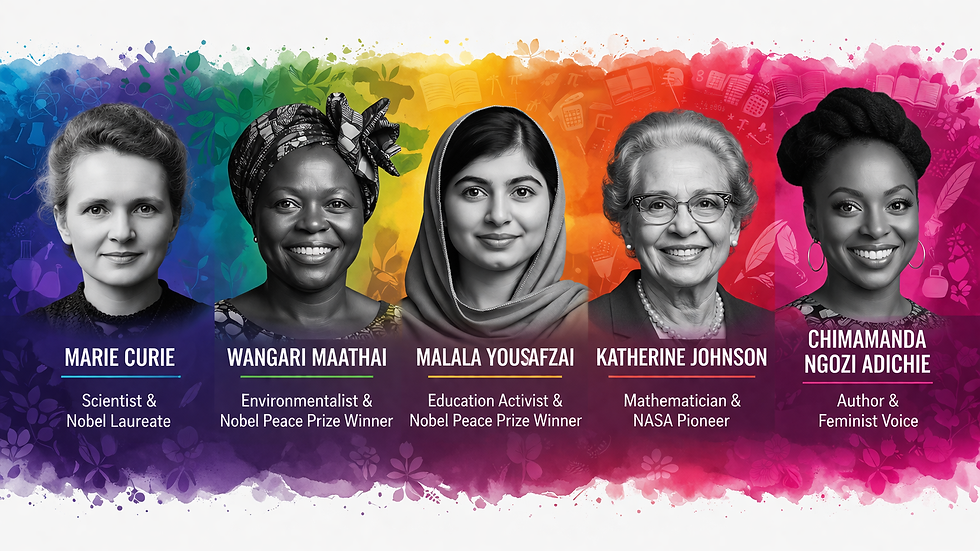
Marie Curie, Paris, France
The place: A small cafe on the Left Bank, close to the Sorbonne. Probably something quiet, because she was not one for noise.
Marie Curie was the first woman to win a Nobel Prize. Then she won a second one, in a different field. She did this while raising children, navigating a world that did not hand women research labs, and carrying on after losing her husband in a tragic accident. She discovered polonium and radium. She coined the term radioactivity. She did it all in borrowed lab space.
Walk through Paris today and her name is everywhere: institutions, streets, a mausoleum at the Pantheon where she became the first woman honored there on her own merit. The city holds her like it knows what it had.
What would you ask her over coffee? We would probably start with: How did you keep going when no one believed you would?
Wangari Maathai, Nyeri, Kenya
The place: Outside, under the trees she planted. No question.
Wangari Maathai founded the Green Belt Movement, which planted more than 50 million trees across Africa. She was also the first African woman to win the Nobel Peace Prize. She connected environmental care to democracy and women's rights long before that conversation was mainstream.
She was jailed. She was beaten. She kept planting.
Nyeri sits at the foot of Mount Kenya, cool and green and full of the kind of quiet that makes you want to think big thoughts. If you ever visit, the landscape itself feels like her legacy: resilient, rooted, reaching upward.
Dinner question: What do you say to the people who told you it was too much?
Malala Yousafzai, Mingora, Pakistan (and now, the whole world)
The place: Her family's kitchen, if she would have us. Simple food. Honest conversation.
Malala grew up in the Swat Valley, a place of extraordinary beauty: rivers, mountains, fruit trees. She also grew up under a regime that told girls they did not deserve an education. She disagreed, out loud, in writing, at the age of eleven.
She survived an assassination attempt at fifteen. She went on to win the Nobel Peace Prize at seventeen, the youngest person ever to do so. She did not stop talking. She still has not.
She is in her twenties now, building the Malala Fund, still showing up. The dinner question almost does not matter. We would mostly just want to listen.
Katherine Johnson, White Sulphur Springs, West Virginia, USA
The place: Somewhere with a good view of the night sky.
Before computers did the math, Katherine Johnson did. She calculated the flight trajectories for the first American in space and for the Apollo 11 moon landing. Astronaut John Glenn refused to fly until she verified the numbers herself.
She was a Black woman working in a segregated NASA in the 1950s and 60s, doing work that shaped history while navigating a building with separate bathrooms and separate dining rooms. She kept doing the math anyway.
West Virginia holds her hometown quietly, but the world knows her name now. She lived to 101. She saw it all.
Dinner question: What did it feel like when they finally got it right?
Chimamanda Ngozi Adichie, Enugu, Nigeria
The place: A long table, lots of food, and no time limit.
Chimamanda is alive and working and brilliant, which means you could actually send her an email (you probably should not, but you could). Her novels and essays have shifted the way millions of people think about identity, feminism, and what it means to tell your own story.
She grew up in Enugu and studied in Nigeria before continuing her education in the United States. Her TED talk, "We Should All Be Feminists," became a book that was distributed to every 16-year-old in Sweden. Beyonce sampled it.
She writes about the danger of a single story, the way one narrow version of a person, a place, or a people becomes the whole truth in someone else's mind. It is one of the most useful ideas in circulation right now.
Dinner question: What story do you think we are still not telling right?
A Table Worth Setting
Here is what these women have in common, besides the obvious: none of them waited for permission. They worked in labs that did not want them, planted trees in countries that locked them up, wrote books that made people uncomfortable, and calculated numbers for missions they would never fly.
And they were all from somewhere specific, a city, a valley, a small town, that shaped them before the world knew their names.
That is the travel angle, if you need one. Go to Paris and think about Marie. Walk in Nyeri and think about Wangari. Look up at the stars from anywhere and think about Katherine.
Or just sit with the question tonight: Whose table would you pull up a chair to, and what would you want to know?
Women's History Month ends March 31st. The stories do not.

Comments